Condominium finance
Condominium accountability: the month-end close step by step
This guide refers to Brazilian condominium law, in which the building manager is the “síndico”.
The year's accountability starts with each month's close. A month closed with documents and checks becomes a folder ready for the assembly. A month left open becomes rework in March.
Who reports on the accounts, and to whom
The building manager is the one answerable for the accounts. The management company prepares the figures and the documents, but the duty to report to the assembly is the manager's.
“It is incumbent upon the building manager: […] VIII – to render accounts to the assembly, annually and whenever required.”
Brazilian Civil Code, art. 1348, VIII (free translation)Once a year, the assembly meets to approve the budget, the contributions and the accounts (Civil Code, art. 1350). When the condominium has an audit committee, it is up to the committee to give an opinion on the manager's accounts (art. 1356).
In practice, many condominiums do not wait for the end of the year: the bylaws or the manager themselves ask for the accounts every month, so the board can follow closely.
What to check before closing the month
- Every expense with a document. Invoice, receipt or paid bill, and the approval of whoever can approve when the amount exceeds the agreed limit.
- Income checked. Dues received, one-off income (party room rental, fines, reimbursements) and what remains open.
- The month's dues generated and checked. The apportionment closed, with each unit's fraction and the metered consumption, when there is any.
- What arrived late goes to the following month. An invoice that arrives after the close goes into the next month. Reopening a month the board has already seen changes numbers that were already read.
- Close and show. A closed month is published so the building manager and the board can review it.
Where accountability usually goes wrong
- Expense without a document. The payment shows up on the statement, but the invoice is in someone's e-mail, or nowhere.
- Approval by message. The manager approved on WhatsApp, and at the assembly nobody can find the conversation.
- Month reopened with no record. A number changes after the board has checked it, and nobody can say what changed.
- Folder assembled only at year-end. Twelve months of documents gathered in a rush, in the week of the assembly.
- A deadline nobody tracks. With many condominiums in the portfolio, one of them having an overdue month only shows up when the manager complains.
How Tribô closes the month
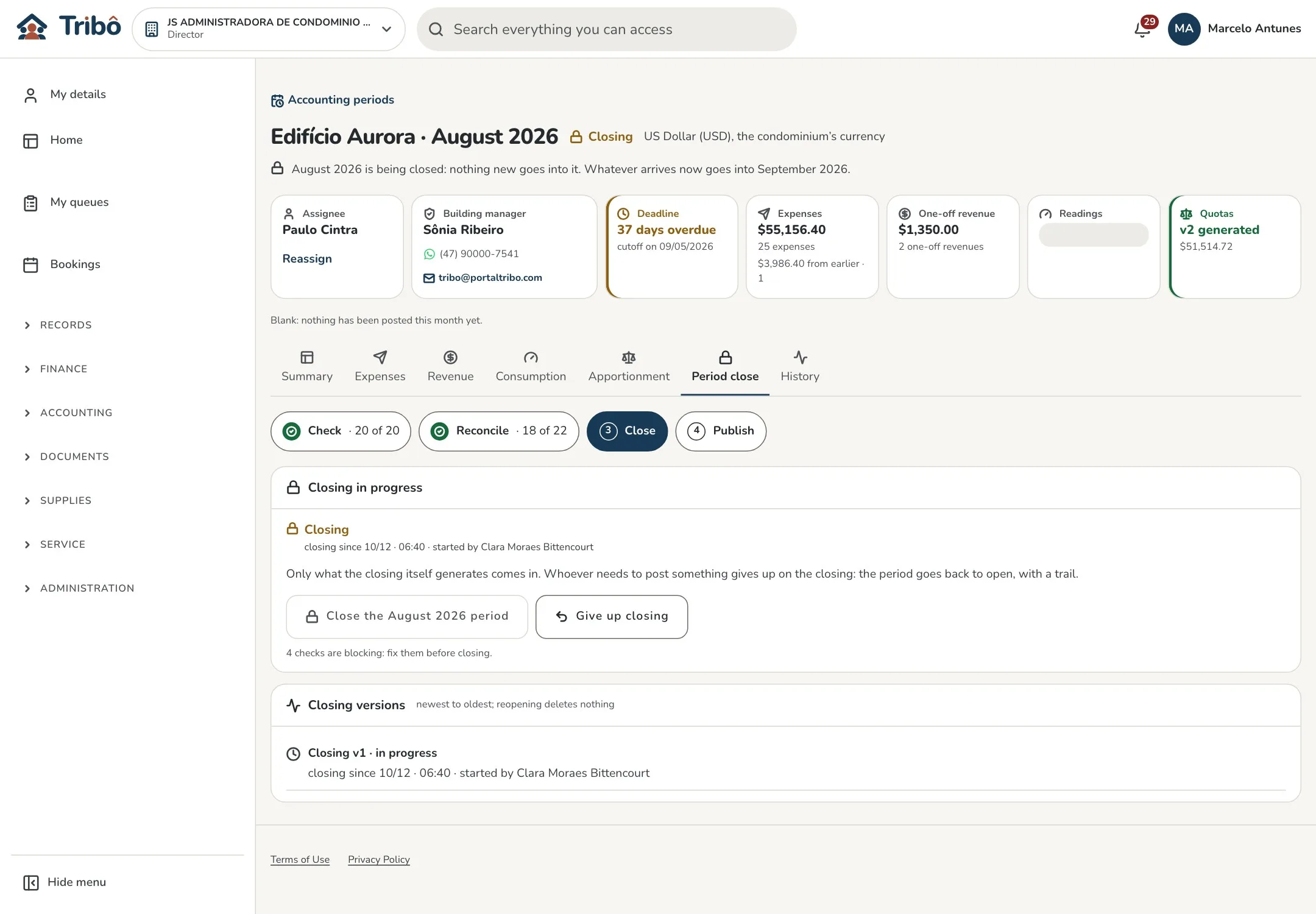
In Tribô, each month of each condominium is an accounting period, which goes through four steps: check, reconcile, close and publish. The screen shows which step each month is at and what is missing for the next.
1. Check
More than 20 automatic checks look at the month before it can be closed. Some block the close until they are resolved:
- expense without a document and without an invoice number;
- expense awaiting approval;
- the month's dues not yet generated;
- meter with no reading;
- balance different from the bank statement.
Others only warn, and whoever closes this way marks that they are aware, with their name recorded. For each open item, the screen says what is missing and where to fix it.
2. Reconcile
The bank statement comes in as an OFX or CSV file, and each transaction is checked against the matching entry: it confirms the pair, records the difference or creates the payment that was missing.
3. Close
When the close starts, the month locks: expenses, income, readings and dues stop changing. An invoice that arrives afterwards goes into the following month, marked as “from earlier periods”. If it is necessary to reopen before publishing, only the director can, never the person who closed, and with the reason in writing. Each reopening becomes a new version, and the earlier ones remain listed.
4. Publish
Once published, the month generates the statement as a PDF, with the apportionment by unit, from what was closed, and stores it in the condominium's archive. A published month does not reopen: the correction is an adjustment in the following month, referencing the corrected month.