Residents and common areas
Booking the party room and common areas in a condominium: rules and how to organize
This guide refers to Brazilian condominium law, in which the building manager is the “síndico”.
The room belongs to everyone, and there is only one Saturday. Clear rules and a calendar everyone can see prevent the fight over the date, the room handed back dirty and the phone call to the management company on Sunday.
What the law says
“The rights of the condominium owner are: […] II – to use the common parts according to their purpose, provided that this does not exclude the use by the other co-possessors.”
Brazilian Civil Code, art. 1335, II (free translation)Booking is precisely a way of organizing that use so that one person does not exclude another. The rules for each space, such as hours, advance notice and fee, go in the house rules, which the bylaws provide for (Civil Code, art. 1334, V) and the assembly approves.
The rules that prevent conflict
- Advance notice. How many days ahead, at minimum and at maximum, a booking can be made.
- Limit per unit. How many bookings each apartment can have per month, so the room is not always taken by the same families.
- Hours and capacity. Until what time the space can be used and how many people it holds.
- Fee and cleaning. If there is a usage fee, how much it is and how it enters the billing, and who cleans afterwards.
- Statement of responsibility. Whoever books answers for the space and for the guests, and signs this beforehand.
- Cancellation. Until when someone can give up without costing another resident the date.
Where booking usually goes wrong
- Notebook at the front desk. The paper calendar only exists for whoever is in the gatehouse, and the page gets torn.
- Booking by message. A resident agrees with the caretaker on WhatsApp, and another resident agrees on the same date.
- A rule nobody read. The house rules are in a folder, and the argument starts when the music goes past the allowed hour.
- Guest stuck at the front desk. The doorman does not know who is on the list, and the resident comes down to let them in one by one.
How Tribô organizes bookings
Each space with its own rules
The management company registers each space as it is, with capacity, up to 8 photos, the rules of use and the opening hours. A space can be booked in four ways: for the whole day, by shift, by range of hours or by occupancy, such as the pool with a maximum number of people per unit. The record also holds:
- the minimum and maximum advance notice;
- the monthly limit and the rule of one active booking per unit;
- who in the unit can book, such as the owner or the tenant;
- the blocked days;
- the statement of responsibility;
- whether the booking is confirmed immediately or depends on the building manager.
When a space closes for renovation or interdiction, it is deactivated with the reason.
The resident books from their phone
The resident picks the space, sees the calendar with what is free, taken or blocked, picks the shift, reads the rules and accepts the statement. If any rule prevents the booking, the screen says which. Under “My bookings” they follow the upcoming ones and cancel before the start, seeing the cancellation deadline.
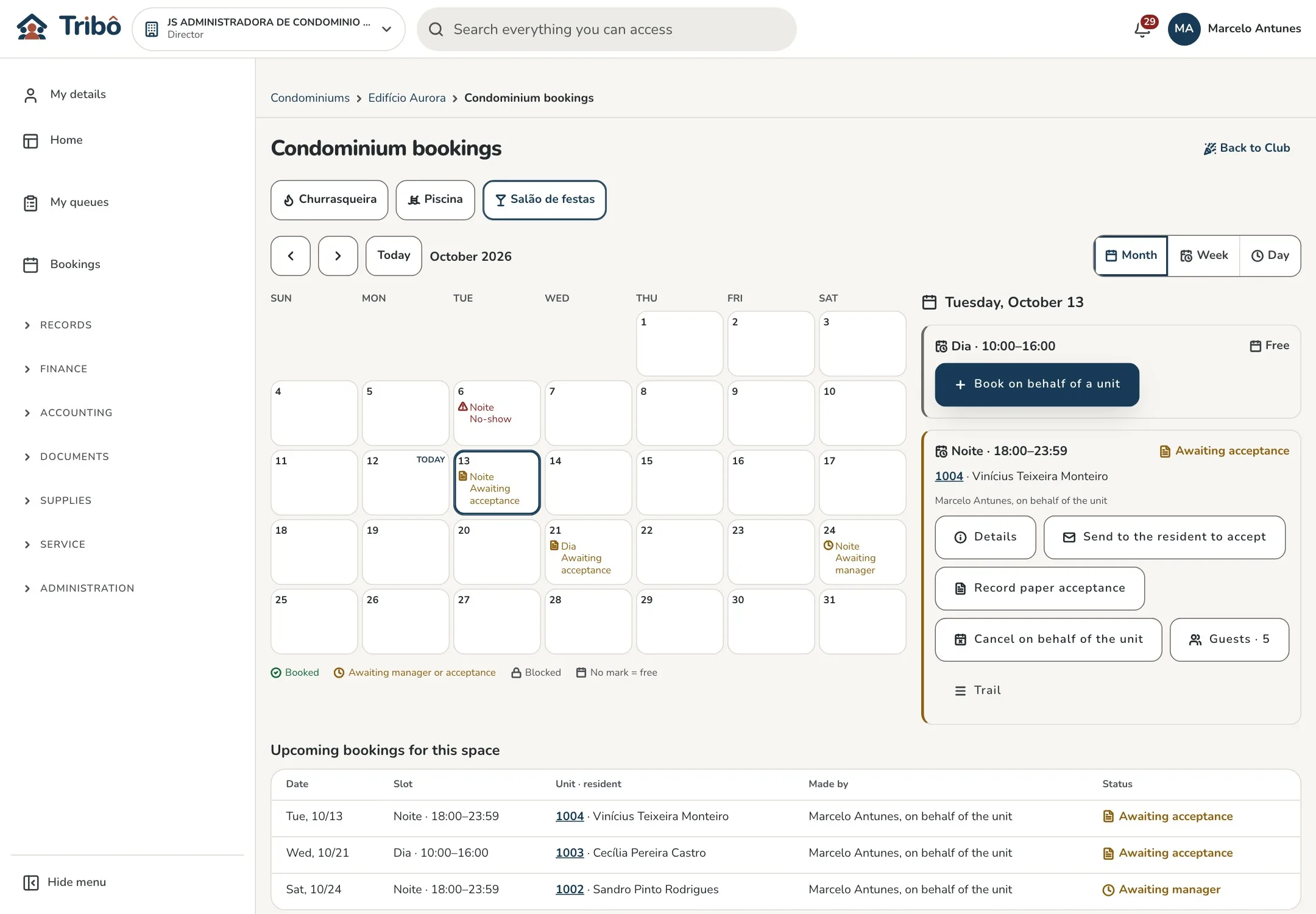
The management company sees the whole calendar
Each condominium's calendar opens by month, week or day. From it, the management company:
- books on behalf of a unit;
- sends the statement for the resident to accept by e-mail or records the acceptance on paper;
- cancels with a reason and marks when nobody showed up;
- builds the guest list.
Each booking has its own trail: who made it, who approved it, who cancelled it.