Condominium finance
Condominium apportionment by ideal fraction: how to calculate it
This guide refers to Brazilian condominium law, in which the building manager is the “síndico”.
The rule is simple: each unit pays the share of expenses that matches its ideal fraction. The work lies in keeping the fractions right, the total closing at 100%, and each month with a record of how the calculation was done.
What the ideal fraction is
The ideal fraction is the share of the land and common areas that belongs to each unit. It is set in the document that establishes the condominium, as a decimal number or a fraction, and it cannot be separated from the unit: whoever buys the apartment buys its fraction with it.
“Each real-estate unit shall be assigned, as an inseparable part, an ideal fraction of the land and of the other common parts, to be identified in decimal or ordinary form in the instrument establishing the condominium.”
Brazilian Civil Code, art. 1331, § 3 (free translation)The fraction usually follows the size of the unit, which is why a penthouse almost always has a larger fraction than a standard apartment. But a fraction is not an area: the number that counts for the apportionment is the one in the document, even when a calculation by area would give a different result.
What the law says about apportionment
“The duties of the condominium owner are: I – to contribute to the condominium's expenses in proportion to their ideal fractions, unless the bylaws provide otherwise.”
Brazilian Civil Code, art. 1336, I (free translation)The ideal fraction is the rule. The bylaws may set another criterion, such as an equal amount for every unit or a separate criterion for the shops. So, before calculating, the first step is to read what the condominium's bylaws say.
How to calculate it, with an example
Unit amount = month's expenses × the unit's ideal fraction
A building with 40 units closed the month with $48,000.00 in expenses. The fractions are in the bylaws:
| Unit | Fraction | How many | Sum | Dues per unit | Total |
|---|---|---|---|---|---|
| Standard apartment | 2.25% | 32 | 72% | $1,080.00 | $34,560.00 |
| Penthouse | 4.50% | 4 | 18% | $2,160.00 | $8,640.00 |
| Shop | 2.50% | 4 | 10% | $1,200.00 | $4,800.00 |
| Total | 40 | 100% | $48,000.00 |
The check that matters most is the sum: the fractions of all the units must close at 100%. If they close at 99.5%, the condominium collects less than it spent every month. If they close at 100.5%, it overcharges everyone.
Where the calculation usually goes wrong
- The fractions do not add up to 100%. One unit with a number copied wrongly from the bylaws is enough for the difference to show up in every bill.
- Fraction confused with area. The area helps with checking, but what rules the apportionment is the fraction in the document.
- Individual consumption mixed into the apportionment. When the building meters water or gas per unit, that part follows each unit's reading, not the fraction.
- Cents left over in the division. With fractions of several decimal places, the sum of the dues rarely matches the expense to the cent. Someone ends up with the difference, and the rule must be the same every month.
- Apportionment redone with no record. When an amount changes after being billed and nobody recorded what changed, who changed it and why, the accountability turns into an argument.
How Tribô does the apportionment
In Tribô, the ideal fraction sits in each unit's record, and the month's apportionment is calculated from it, with every step in view before any billing.
The right fraction in the record
- The ideal fraction is entered on each unit, with up to 9 decimal places, by hand, by spreadsheet or when creating units in bulk.
- When the fractions do not add up to 100%, the unit list warns you, says how much is missing or in excess and how many units have no fraction.
- Without the fractions at hand, Tribô suggests a proposal based on each unit's declared area, with the sum closing at exactly 100%, and reminds you that the number that counts is the one in the founding document.
- Each condominium's criterion follows its bylaws: ideal fraction, private area or an equal amount for all units.
The month's dues in four steps
- Base: checks that every unit in the apportionment has a fraction. If any is missing, Tribô says which and does not let the dues be generated.
- Components: the dues are the sum of the month's parts, each with its own criterion: the approved budget, the actual expense, each unit's metered consumption, the reserve fund as a percentage and the extra dues in installments, with the minutes.
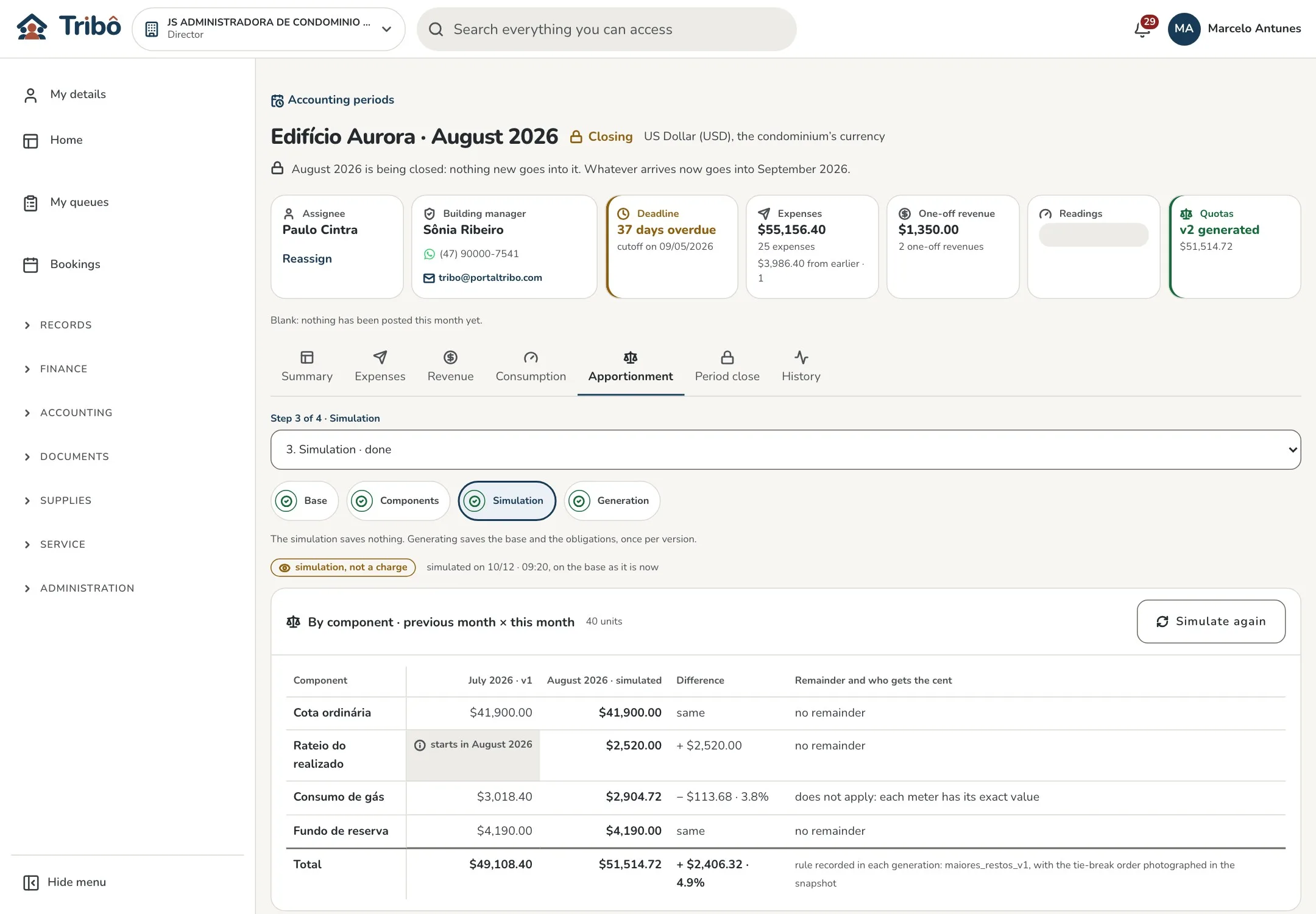
- Simulation: shows each unit's amount, part by part, compared with the previous month, without saving anything. You can filter the units that changed by more than 5%.
- Generation: saves the dues as a version, with who generated it and when. The cent left over in the division always follows the same rule, and the screen shows who got it.
If a correction is needed later, the version is reversed with the reason in writing and a new one is generated. Both stay in the history.