Condominium finance
Condominium expense approval: the building manager's limit and the record of who approved
This guide refers to Brazilian condominium law, in which the building manager is the “síndico”.
Who can authorize each expense, up to what amount, and where the record is kept. With that agreed, the management company pays without doubt, and the building manager answers the assembly's questions with proof in hand.
What the law says about condominium spending
The Civil Code separates expenses by the type of work and the size of the spend.
“Necessary works or repairs may be carried out, without authorization, by the building manager or, if the manager fails or is unable to act, by any condominium owner.”
Brazilian Civil Code, art. 1341, § 1 (free translation)- Necessary and urgent, but costly: it may be done, and the manager informs the assembly, which must be convened immediately (art. 1341, § 2).
- Necessary, costly and not urgent: only after the assembly's authorization (art. 1341, § 3).
- Useful works: depend on a majority vote of the owners. Voluptuary works, for embellishment or comfort, need two thirds (art. 1341, I and II).
The law does not say what an “excessive expense” is. That is why the bylaws or the assembly usually set an amount: up to it, the spend follows the budget; above it, someone has to approve first.
How to agree on the limit
- A clear amount, in dollars. “Expenses above $2,000.00 need the building manager's approval” leaves no room for interpretation.
- Who approves, in writing. The building manager, and whoever approves when the manager is absent.
- The document before the approval. Quote or invoice attached, so whoever approves knows what is being approved.
- The record kept. Who approved, when and, if returned, why.
Where approval tends to get lost
- Approval by message. A “go ahead and pay” on WhatsApp vanishes into the conversation, and at the assembly nobody can find it.
- Invoice paid before being approved. The bill falls due, someone pays, and the approval becomes a formality after the fact.
- Building manager absent. Travel, vacation or a change of manager mid-month, and the expense sits there with no owner.
- Spend split to fit under the limit. Two invoices of $1,900.00 instead of one of $3,800.00.
- Nobody can say who approved. Months later, the question comes and the answer depends on someone's memory.
How Tribô handles approval
One limit per condominium
Each condominium has its own limit in dollars, in the condominium's record. Only the management company's director changes that amount, and each change is recorded without altering what already happened. A limit of zero means every expense goes through the building manager.
The request is born with the expense
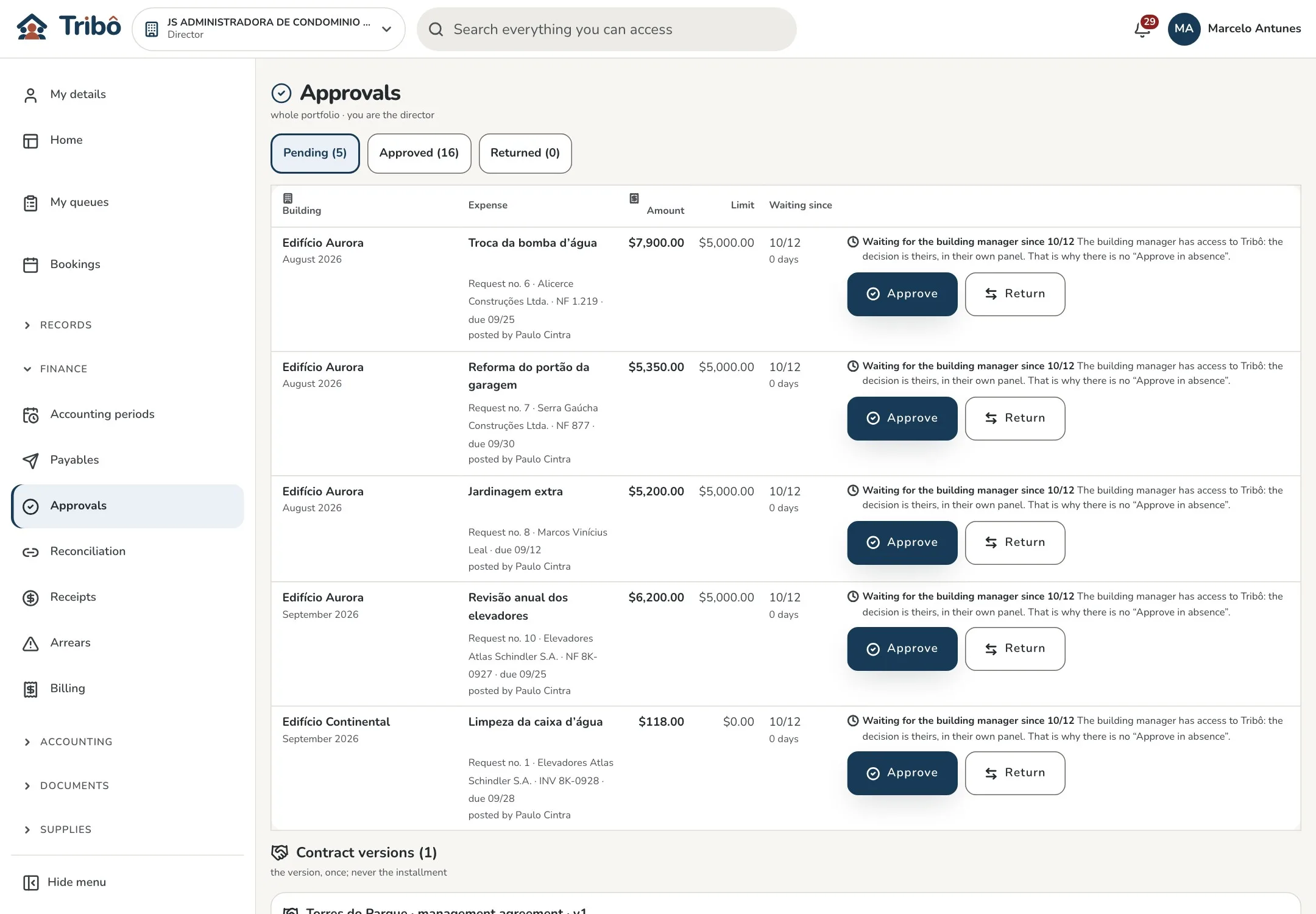
When the management company enters an expense above the limit, the approval request goes straight to the building manager, with its own number in the condominium. For an expense paid in installments, the total counts.
What the building manager sees before deciding
- what the expense is, the amount, the supplier and who requested it;
- the attached documents, such as the quote and the invoice;
- where the money comes from, the due date and the year's budget;
- the condominium's limit and how far the expense goes over it.
The manager approves or returns it. Whoever returns it writes the reason, which goes back to whoever requested it. Whoever entered the expense cannot approve it, not even when that person is the building manager.
No approval, no payment
While the request is not approved, Tribô refuses payment by any route: on screen, in statement reconciliation and in batch payment. A pending request also prevents closing the month.
When the building manager is not in the system
If the manager authorized it outside the system, the management company's director records the approval with the proof: the e-mail, the message or the paper, and the date. If the condominium has no building manager, or the manager has no access to Tribô, the director can decide in their absence, and that decision appears marked in the published month.